
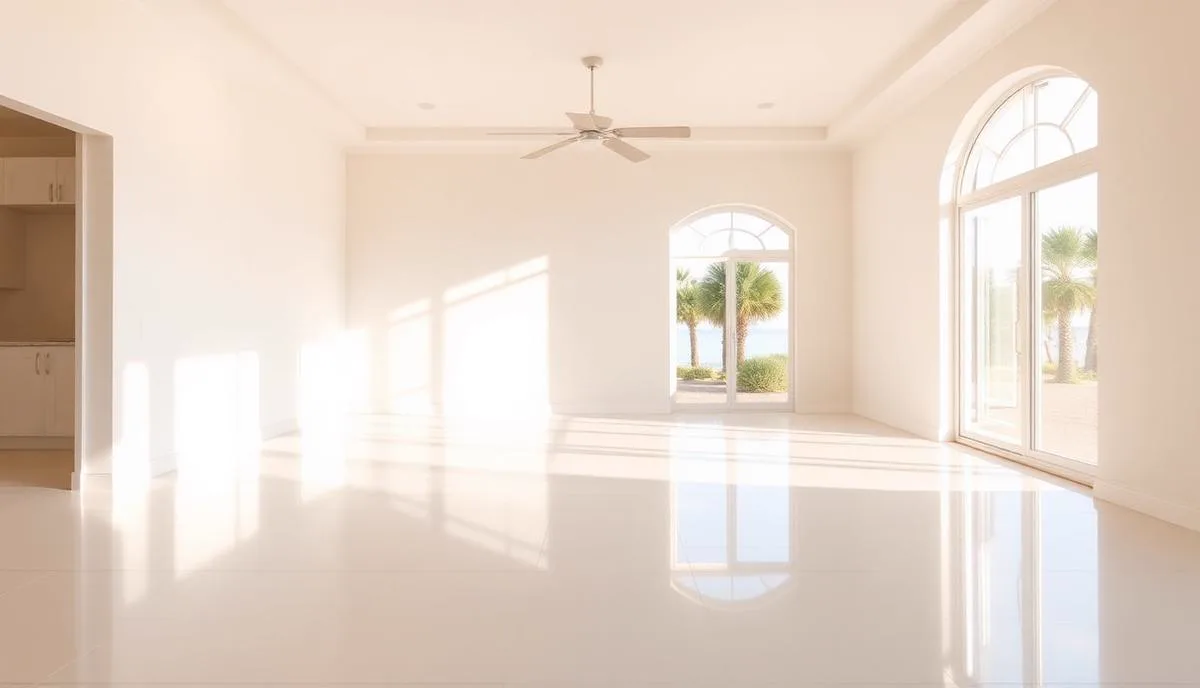
Almost everyone cleans a new home at some point. The question is only whether it happens in the few days while the place is empty, or in stages over the following year, around furniture, with a full life already running on top of it.
The case for doing it first is not that an empty house is nicer to clean, though it is. It is that a handful of places in any house are reachable exactly once — in the gap between getting the keys and the truck pulling up — and after that they are sealed under a refrigerator or behind a wardrobe until the next time you move.
Clean after closing, before the truck. The same house takes fewer hours empty than furnished, the result is better, and roughly a dozen jobs stop being possible the moment furniture lands. Budget it as a deep clean, not a standard visit.
"Broom Clean" Does Not Mean Clean
Most purchase contracts oblige the seller to leave the property in broom clean condition, and most buyers read that as a promise the house will be clean. It is not. Broom clean means the seller's belongings and rubbish are gone and the floors have been swept. That is the extent of it.
It does not cover inside cabinets, inside the oven or refrigerator, bathrooms, baseboards, window tracks, or under any appliance that stays with the house. A seller who hands over a genuinely clean home is being decent — not meeting a standard. And by the time you notice the difference, they have your money and you have their kitchen.
Nor does a pre-closing walkthrough catch it. Walkthroughs are for verifying that agreed repairs happened and that nothing broke since the inspection. Nobody opens the dishwasher filter during one.
What Furniture Seals Away, and For How Long
This is the part that makes the timing matter rather than just being convenient. Every item below is straightforward while the house is empty and effectively out of reach afterwards:
| Where | Reachable again | What is actually there |
|---|---|---|
| Under and behind the refrigerator | Your next move | Coils, the floor beneath, and the wall behind. Once it is pushed into its alcove with a water line attached, nobody moves it again casually. |
| Behind the washer and dryer | Your next appliance failure | Lint, dust and whatever the last household dropped down the gap. Also the one place a slow supply-line drip goes unnoticed for years. |
| Closet floors, shelves and rails | You empty the closet | Ten minutes while empty. A weekend project once it holds a household's clothes and boxes. |
| The tops of the kitchen cabinets | Effectively never | Airborne cooking grease settles there and hardens into a film that collects dust. Reaching it needs a ladder and an empty counter. |
| Inside every cabinet and drawer | Piecemeal, over years | Crumbs, liner residue and the occasional pantry pest. Trivial now, and never done all at once again. |
| The wall and floor behind large furniture | You redecorate | Sofas, beds and wardrobes go against a wall on day one and stay there. Whatever is on that wall stays too. |
| Window tracks and slider channels | They stop sliding | In Sarasota these fill with sand and grit, which is what eventually wrecks the rollers. |
None of these are dramatic on their own. Together they are the difference between a house that was cleaned once, properly, at the start — and one that has a permanent layer underneath it that nobody has ever touched.
What the Last Household Left Behind
An empty house looks clean because there is nothing in it. These four are the ones that reliably survive a seller's tidy-up:
Two situations deserve naming separately. If the previous owners had pets, dander is in the carpet backing and the HVAC, and that needs extraction plus a filter change rather than vacuuming. If anyone smoked in the house, the nicotine film on walls and ceilings has to be washed off before painting — paint applied over it yellows from underneath within months.
What an Empty House Does to Itself Here
A Sarasota home usually sits vacant for weeks between listing photos and closing, often with the air conditioning off or set high to save money. That has consequences a house in a dry climate would not have:
The practical instruction is short: get the AC running the day you get the keys, not the day you move in. Everything else — cleaning included — works better once the house has had a couple of days to dry out. It is the same principle we cover for a guest room that has been shut all summer, on a whole-house scale.
Fitting It Around the Moving Truck
The gap between closing and the truck is usually one to three days, and occasionally the same afternoon. Booking blind against that is the main reason people end up cleaning after the move instead.
- Book on the contract date, not the closing date. As soon as you have a scheduled closing, reserve the clean for the day after it. Moving it later is easy; finding a crew at two days' notice in season is not.
- Turn on the AC and the water first. Nobody can clean a house with no running water, and a humid house cleans badly. Both should be live before anyone arrives.
- Walk it with a camera before anyone starts. Not for cleaning — for you. An empty, well-lit house is the only chance you get to document its actual condition, and it is when you will spot a slow leak under a sink or a stain that was under a rug.
- Schedule the clean to finish before the truck, not overlap it. Movers and cleaners in the same house means both do a worse job and neither can be held to a result.
- Leave the closets for last if you are doing it yourself. They are quick while empty and they are the first thing that gets filled.
Move-In and Move-Out Are Not the Same Work
They get sold as one service and they are genuinely different jobs with different customers and different definitions of success.
| Move-out | Move-in | |
|---|---|---|
| Judged by | A landlord or buyer with a checklist and a deposit | You, living in it, for years |
| Priority | Visible surfaces and anything on an inspection list | Hygiene and the places about to be sealed under furniture |
| Deadline | Handover — immovable | The truck — usually a day or two of slack |
| Deep work | Whatever the contract or lease specifies | Inside appliances, HVAC grilles, closets, under everything |
If you are doing both ends of a move in the same week, they are two bookings, not one — and the outgoing property has its own rules. Our move-in and move-out service covers both, from $299 for a typical home, and takes four to eight hours depending on size and condition.
The Bottom Line
Cleaning before you unpack is not about starting fresh as a feeling. It is that a house has one week in its life when all of it is reachable at once, and that week happens to be the one you are least inclined to spend on it. Book it for the day after closing and it takes care of itself while you are busy elsewhere.
DS Cleaning handles move-in and move-out cleaning across Sarasota, Bradenton, Lakewood Ranch, Venice and nearby communities. New to the area and working out what things cost here, our Sarasota cleaning price guide has the real numbers, and the calculator gives an estimate in about two minutes.
Frequently asked questions
Looking clean and being clean are different tests, and an empty house hides very little visually while hiding a lot structurally. What a walkthrough will not show you is the grease film on top of the kitchen cabinets, the previous owner's hair in the bathroom extractor, dander in the HVAC returns, or what is under the range. A move-in clean is not really about how the house looks on the day — it is about the places you will not be able to reach again once your furniture is standing on them.
Close to the literal meaning: the property is emptied of the seller's belongings and rubbish, and the floors are swept. That is the whole obligation. It does not cover inside cabinets, inside appliances, bathrooms, baseboards, window tracks, or anything behind or under an appliance that stays with the house. Sellers who leave a home genuinely clean are being decent, not compliant — and buyers who expect it as standard are usually disappointed on move-in day.
Before, and it is not close. The same house takes fewer hours to clean empty than furnished, the result is better because nothing is being worked around, and several jobs are simply impossible afterwards without emptying rooms again. Cleaning after the truck also means living in the house while it happens, which is the one thing everyone wants to avoid in a moving week.
For a typical three-bedroom Sarasota home in reasonable condition, four to eight hours, which is deep-cleaning territory rather than a standard visit — inside every cabinet and drawer, inside the appliances that convey, all bathrooms to sanitised, baseboards, window tracks, and behind and under whatever can be moved. Homes that sat vacant through a Florida summer, or that had pets, take the upper end of that.
Both need more than a surface clean, and both are worth knowing about before you unpack. Pet dander settles into carpet backing and circulates through the HVAC system, so it usually needs carpet extraction and, separately, a filter change and vent clean by an HVAC contractor. Nicotine leaves a film on walls and ceilings that yellows fresh paint from underneath — it has to be washed off before anyone paints, not painted over, and that is a job to identify while the house is empty rather than after you have decorated.

Nadiia Soroka is the owner of DS Cleaning, a professional residential cleaning company serving Sarasota, Bradenton, and the surrounding Gulf Coast.
More articles by Nadiia →