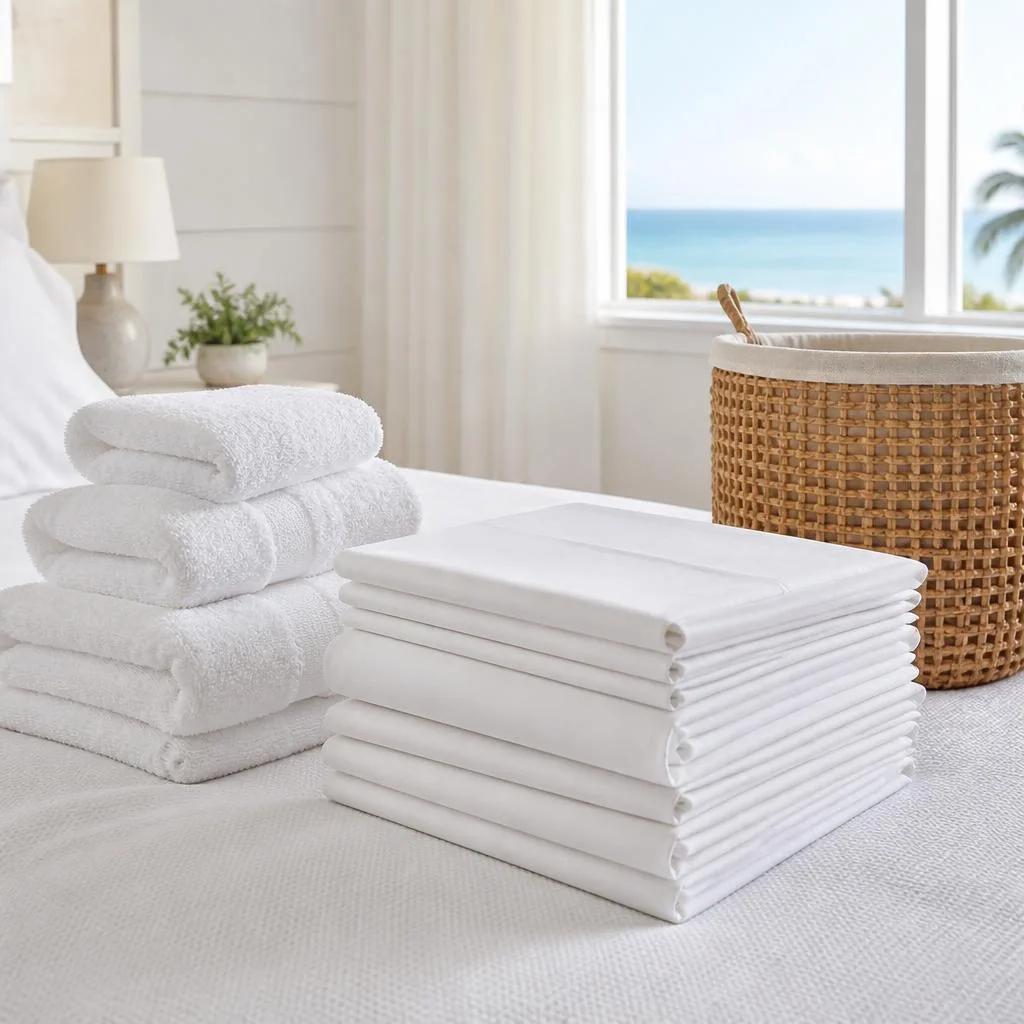
Linen is the only part of a turnover that cannot be rushed. Everything else responds to working faster or adding a second pair of hands; a dryer takes the time it takes. That is why linen is not a supplies question — it is the scheduling constraint that decides whether a same-day changeover is possible at all.
Our turnover playbook covers the cleaning sequence around it. This one is the system underneath: how much linen to own, where the washing should happen, how to wash it so it stays white, and what to do about the stains every Gulf Coast rental eventually gets.
Own three sets per bed so the cleaner beds from stock instead of waiting on a dryer. Wash white linen hot, half-loaded, with no fabric softener. Keep beach towels as separate stock, and never put a sunscreen-stained item in the dryer.
Sizing Par Levels for Your Actual Bookings
"Three sets per bed" is the right starting number, but it is a consequence, not a rule. The logic is that at any moment one set is on the bed, one is clean and ready, and one is in the wash. Break any of those three states and the system stalls.
Which means the number goes up whenever a set spends longer in the wash state:
- Four sets if you run same-day back-to-back changeovers, where a set has no overnight to dry.
- Four sets if laundry goes off site on a 48-hour cycle — the set is out of the building for two days.
- Four sets through January to April on Siesta Key, Anna Maria Island and Longboat Key, where booking density leaves no slack.
Towels do not follow the bed count. Guests use two or three bath towels each across a stay, so count towels per guest at maximum occupancy, then multiply by your set number. A two-bedroom sleeping six needs towel stock for six people three times over, not for two beds.
Beach towels are a separate inventory entirely, and keeping them separate is not fussiness. Sunscreen, tanning oil and sand all end up in beach towels, and once those mix into your bathroom stock the staining problem below becomes permanent. Buy them in a dark colour so they are visually impossible to confuse with bath towels.
Three Models, One Real Decision
Most hosts never consciously choose this — they default to the machines already in the unit and discover the limits during their first busy season.
| Model | Suits | Effect on the turnover | Cost shape |
|---|---|---|---|
| On-site, in-unit machines | One property, flexible calendar, gaps between bookings | Laundry sets the finish time — the dryer, not the cleaner, decides when the unit is ready | Almost no cash cost, high time cost, plus wear on machines you own |
| Off-site wash and fold | Two or more properties, or any unit with back-to-back bookings | None, if par levels cover the turnaround — the cleaner beds from stock | Priced by weight; predictable and easy to pass into the cleaning fee |
| Linen rental and exchange | High-volume hosts and small portfolios wanting zero linen admin | None — dirty out, clean in, on a fixed schedule | Highest per changeover, but no capital outlay and no replacement budget |
The honest read: on-site laundry is not free, it is paid for in the only hours you cannot buy more of. If your calendar has gaps, that trade is fine. The moment you are turning over same-day, moving laundry off the critical path is usually worth more than it costs. We handle both on-site laundry and linen exchange as part of turnover cleaning, so the choice does not have to be permanent.
Keeping White Linen Actually White
Rental linen fails visually long before it fails structurally. Five specifications do most of the work:
If you are handling mixed loads yourself between changeovers, our guide to sorting laundry properly covers what can safely share a drum — useful when the rental whites are running alongside coloured throws and cushion covers.
Sunscreen Stains, and Why They Appear After Washing
Every beach rental host eventually pulls a load of white towels out of the machine covered in orange or rust-coloured blotches that were not there when they went in. The usual conclusion is that the machine is leaking rust. It almost never is.
The cause is avobenzone, the UV filter in most sunscreens. It reacts with iron and mineral content in hard water and turns orange — a reaction that happens during the wash, which is exactly why the stain seems to appear from nowhere. Southwest Florida water is hard enough that this is a routine event rather than an unlucky one.
The critical rule is that heat sets it permanently. A stained item that goes through a dryer is finished — no later treatment will lift it. The protocol:
- Treat the oil first. Work a degreasing dish soap into the stain, because it is an oil stain before it is a colour stain, and oxygen bleach cannot reach through grease.
- Soak in oxygen bleach in warm water for several hours, or overnight for older marks.
- Wash warm — hot is not required and increases the risk of setting anything you missed.
- Inspect while damp, before drying. Damp fabric shows the stain clearly; dry fabric hides it until it is too late.
- Repeat if needed. Only when it is genuinely clear does the item go in the dryer.
Prevention beats treatment: dark, separate beach towels, a note in the welcome book asking guests to use them poolside, and a rule that bathroom stock never leaves the bathroom. If sunscreen and tanning oil have already reached upholstery or a mattress protector, that is a different job — see upholstery cleaning.
Linen Storage in a Humid Climate
Clean linen can still greet a guest smelling stale, and the storage cupboard is usually why. Three rules cover it:
- Bone dry or not stored. A slightly damp folded towel in a Florida cupboard turns musty within hours, and the smell survives the next wash.
- Air, not seal. Linen wants a ventilated shelf, not an airtight bin. Sealed plastic containers and garage storage are reliable ways to produce mildew.
- Rotate from the bottom. Put freshly laundered sets underneath the stack. Without that, the top three sets do all the work and the bottom ones sit for months developing exactly the smell you were trying to avoid.
Date-code every set with a laundry marker on the care tag when it arrives. It takes seconds and it is the only way to answer "how old is this?" a year later — which is what makes a replacement budget possible instead of a replacement panic.
Six Things That Break the System
The Bottom Line
A linen system is worth setting up once because it removes a recurring decision. Three sets per bed, towels counted per guest, beach towels kept separate and dark, hot half-loads with no softener, and nothing folded or dried until it is genuinely clean and genuinely dry. That is the whole system, and it survives a rushed Saturday in March — which is the only real test.
DS Cleaning handles turnover cleaning with linen management across Siesta Key, Anna Maria Island, Longboat Key, Holmes Beach, Bradenton Beach and the wider Sarasota area — on-site laundry or linen exchange, whichever suits your calendar. For how that fits into overall costs, see our Sarasota cleaning price guide.
Frequently asked questions
Three sets per bed is the working minimum: one on the bed, one clean and ready, one in the wash. Move to four when you run same-day back-to-back turnovers, when laundry goes off site on a 48-hour cycle, or through peak season on the keys. Towels need more than beds do — guests use two or three bath towels each over a stay — so count towels per guest at maximum occupancy rather than per bedroom, and keep beach towels as an entirely separate stock.
That is sunscreen, not rust. Avobenzone, the UV filter in most sunscreens, reacts with iron and minerals in hard water and turns orange — and the stain often appears during or after washing rather than before, which is why hosts assume the machine caused it. Heat sets it permanently, so a stained item must never go in the dryer. Treat the oil first with a degreasing dish soap, soak in oxygen bleach, wash warm, then check while damp and repeat before drying.
No — it is the most common and most damaging linen mistake in short-term rentals. Softener works by coating fibres with a waxy residue, which is exactly what destroys a towel's absorbency. A guest dries themselves with a soft towel that does not work, and that reads as a cheap rental. The residue also traps moisture and odour, which in Florida humidity turns into the musty smell guests notice at the door. Use wool dryer balls instead, and strip existing buildup with a hot wash and a cup of white vinegar.
Rarely cheaper per pound, and often worth it anyway. On-site laundry has almost no cash cost but consumes the scarcest resource in a turnover — the hours between checkout and check-in. A wash-and-fold service costs real money per load but removes laundry from the critical path entirely, provided your par levels are high enough to cover the turnaround. The break-even is usually the second property, or the first season with back-to-back bookings.
Bath towels last about two years in rental use and sheets roughly eighteen months to two years, but the calendar matters less than the condition. Retire anything pilled, thinning at the hem, greyed, or permanently stained — guests read all four as dirty regardless of how clean the item is. Date-code each set with a laundry marker on the care tag when you buy it, otherwise you cannot tell a one-year-old set from a four-year-old one, and budget replacement as a running cost rather than an emergency.

Nadiia Soroka is the owner of DS Cleaning, a professional residential cleaning company serving Sarasota, Bradenton, and the surrounding Gulf Coast.
More articles by Nadiia →