
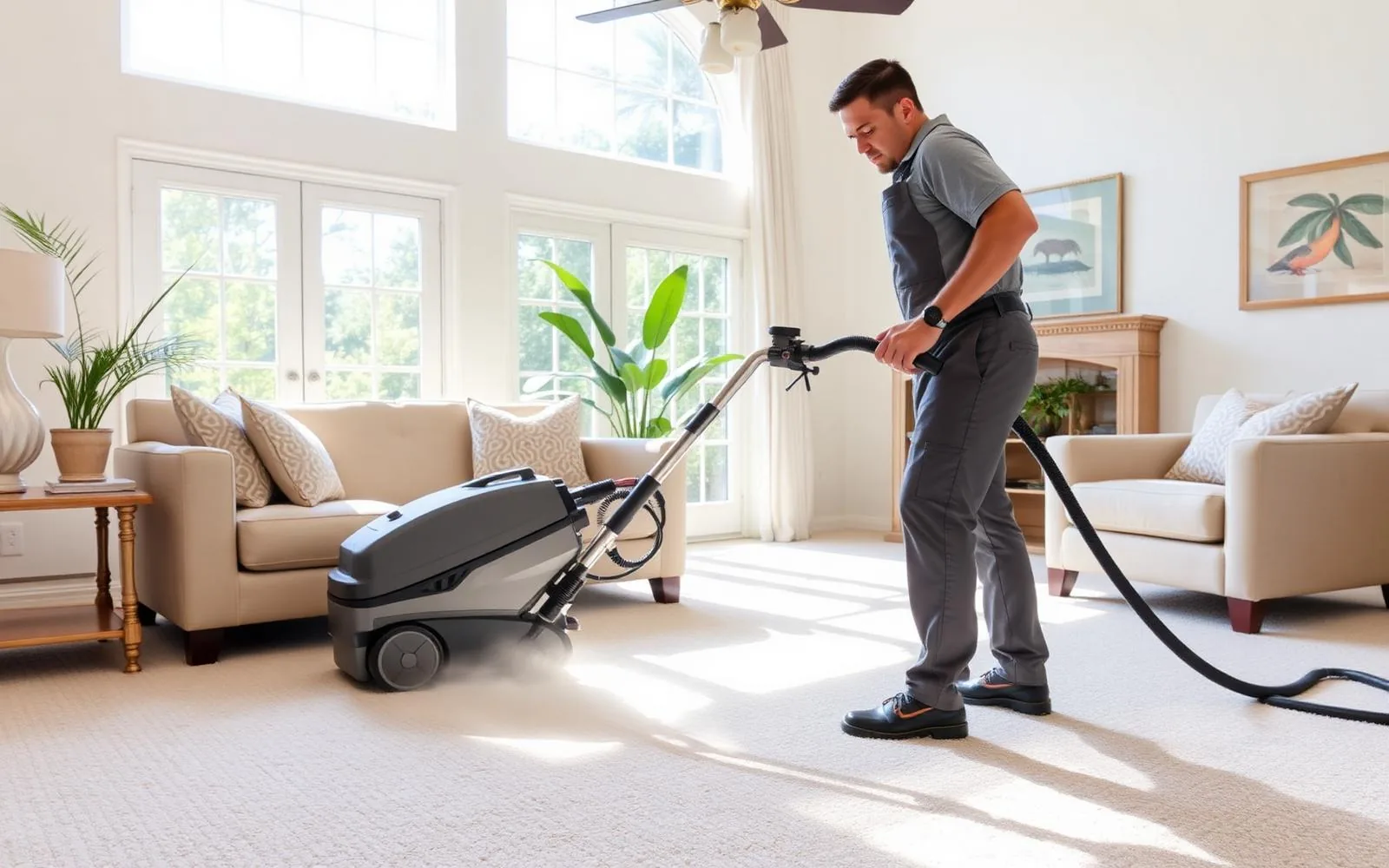
Most advice about carpet cleaning is written for a climate that is not this one. It compares methods, argues about steam versus dry, and treats drying as a footnote — something that happens on its own after the interesting part is over.
On the Gulf Coast the footnote is the whole thing. Cleaning a carpet is, briefly, wetting it. In a dry climate that is trivial. Here, in September, with the air already holding about as much water as it can, a carpet that is not dried deliberately is a warm damp substrate in a warm damp house — and that has a well-documented head start measured in hours, not weeks.
Judge a carpet clean by how fast it dries, not how wet it got. Keep the house closed with the AC running while it does — opening the windows here usually adds moisture. And never book a clean for the week you are closing the house up.
Dry Time Is the Number Worth Asking About
When people compare carpet cleaners they ask about the method. It is the wrong first question, because both common methods work and the fibre largely settles which one is appropriate anyway.
The question that separates a good job from a bad one here is how much water is left in the carpet when the crew drives away, and how long it takes to leave. That is a function of extraction power and technique rather than of the label on the service. A machine with real vacuum recovery pulls back most of what it put down; a weak one rinses the carpet and leaves the rest for your house to deal with.
So the useful thing to ask is not "steam or dry?" but "how long until it is dry, and what should I be doing while it is?" A cleaner who answers that precisely has thought about your building. One who says it will be fine has not.
The Pile Dries First and Tells You Least
Carpet is four layers, and they dry at wildly different speeds. Almost every drying mistake comes from reading the top one and assuming it speaks for the rest:
The pad is the layer that matters and the one you cannot inspect. It is dense, it is sandwiched against the subfloor, and essentially no air reaches it. This is the same reason a pet-friendly property accumulates problems invisibly — the reservoir is underneath, out of reach of anything you do on top. We went into that at length in the piece on what a pet fee really has to cover; here the substance in the pad is water rather than allergen, but the geometry is identical.
Why the First Day Is the Whole Game
The widely cited figure in the restoration trade is that damp material in warm conditions can begin supporting mould growth in roughly 24 to 48 hours. That number is usually quoted about flood damage, which makes it sound like it belongs to a different category of problem. It does not. It is a property of wet material and warm air, and a carpet is wet material.
A properly extracted carpet in a conditioned house is comfortably inside that window — a few hours, not a day. The risk lives entirely in the gap between those two states: the carpet that was over-wetted, or the house where nothing was done to help it dry. Every practical recommendation below is about staying on the right side of that gap.
It is also why the smell arrives before anything visible does. Musty is not an aesthetic complaint; it is the earliest signal you get, and by the time a carpet smells the process is already underway somewhere you cannot see.
Opening the Windows Usually Makes It Worse Here
This is the piece of standard advice that does not survive the trip to Florida, and it is repeated everywhere — including, until recently, in our own service page FAQ.
Ventilation dries things when the air you let in holds less moisture than the air already inside. That is true in most of the country for most of the year. It is not true here for a great deal of it: for months at a stretch the outdoor air is carrying more water than the conditioned air in your house, and opening up simply swaps drier inside air for wetter outside air. You are not ventilating the carpet. You are watering it, slowly, with the sea breeze.
Air conditioning is the right tool precisely because it is not only a cooler. It is a dehumidifier that happens to cool: warm moist air passes over a cold coil, water condenses out and drains away, and drier air comes back into the room. Leave the house closed, set the thermostat where you normally keep it, and let it work.
Do not crank the thermostat down to speed things up. A very cold house condenses moisture onto cold surfaces and the system short-cycles, so it runs less and dehumidifies less. Normal temperature, fans on, doors between rooms open — that combination beats a cold empty house every time.
Conditions Should Pick the Method, Not Just the Fibre
Hot-water extraction is what most carpet manufacturers recommend and what most homes should get: it flushes soil out of the fibre rather than suspending it, and with proper recovery it does not leave much behind. Low-moisture methods use a fraction of the water and dry far faster, at the cost of some depth.
The usual rule is that the fibre decides. That is right, and incomplete — because the ability of the building to dry is just as real a constraint as the material:
| Situation | Leans toward | Why |
|---|---|---|
| Ordinary synthetic carpet, occupied house, AC running | Hot-water extraction | Deepest clean, and the conditions to dry it properly are already there |
| Wool, delicate or natural fibre | Low moisture | Fibre decides this one outright — too much water risks shrinkage and browning |
| House closing up within a few days | Low moisture, or postpone | Nobody will be there to see it finish drying |
| No working air conditioning | Postpone | There is no dry-down path; cleaning first and hoping is how smells start |
| Ground floor of an elevated or waterfront home | Low moisture, plus a dehumidifier | Ambient moisture is higher and airflow is usually worse |
| Vacation rental between back-to-back bookings | Low moisture | The clock, not the fibre — guests arrive before extraction would finish |
| Carpet already wet from an intrusion | Neither — call remediation | This is water damage on a clock, not a cleaning job |
The Worst Week of the Year to Book It
The single most avoidable carpet problem we see is not a bad clean. It is a good clean scheduled three days before the owners fly north.
The sequence writes itself. The carpet is cleaned. The house is packed up. The thermostat goes up to save money, or off entirely. The doors close on a building that still has moisture in it and no longer has anything moving air or pulling water out. Six months later someone opens the door in November and the house smells like a basement — and the cleaning gets the blame, fairly enough, because it supplied the water.
If you are a seasonal owner, put the carpet clean at the start of your time here rather than the end. It is better for you anyway: you get the season on a freshly cleaned carpet instead of leaving one behind for an empty house. The seasonal open-up and close-down guide covers how the rest of that sequence should run.
The same logic applies to a rental between bookings. If the gap is a few hours rather than a few days, that is a low-moisture job or no job — a guest walking onto damp carpet will mention it, and they will be right to.
What Actually Helps on the Day
None of this is difficult, and all of it changes the result more than the choice of company does:
The furniture-leg one sounds fussy and is the one people regret skipping. Damp carpet takes a stain from wood finish or a rust mark from a metal foot in a few hours, and unlike soil, that does not come out later.
When Cleaning Is the Wrong Call
Three situations where a cleaner should talk you out of it, and where we do:
- The carpet is already wet from an intrusion. A leak, a failed appliance, a storm, water that came up rather than down. That is water damage with a clock on it, and it needs moisture readings and drying equipment — quite possibly with the carpet lifted and the pad discarded. Cleaning it is treating a symptom while the problem continues underneath. Our storm reopening guide walks the line between the two.
- The smell comes back within days of a clean. That is not a carpet that needs cleaning again. Something is feeding it — a slab issue, a slow leak, or contamination already in the pad — and each additional cleaning adds water to the thing causing it.
- The carpet is delaminating or worn through. Rippling, a backing separating from the fibre, traffic lanes gone to the weave. Cleaning makes worn carpet look worse, not better, because it removes the layer of soil that was evening out the appearance. At that point the honest advice is replacement.
The Bottom Line
Carpet in this climate is not high-maintenance, it is just unforgiving about one specific thing. Get the water out and back into the air-conditioning system quickly and carpet does well here for years. Leave it in, or hand it to a closed-up house, and the problem starts underneath where nothing you do afterwards reaches it.
So: ask about dry time rather than method, keep the house shut with the AC running while it finishes, and never clean the week you leave. DS Cleaning handles carpet cleaning and upholstery cleaning across Sarasota, Bradenton and Lakewood Ranch — and will tell you when the answer is to wait, or to call someone else entirely.
Frequently asked questions
Run the air conditioning, and leave the windows shut. This is the one piece of standard advice that does not travel to Florida. Opening windows only helps when the outdoor air is drier than the air indoors, and for a large part of the year here it is not — you are ventilating moist outside air into a house you have been paying to dehumidify. Air conditioning does two jobs at once: it moves air and it pulls water out of it. Set it to a normal temperature rather than an unusually low one, add ceiling fans for air movement, and keep the house closed until the carpet is dry to the touch well down in the pile.
Press hard with a folded dry towel or a bare heel in the traffic lane, hold for a few seconds, and look at the towel. The surface pile dries first and can feel completely finished while the backing and pad below are still holding water, so a light touch tells you very little. Corners, edges against the baseboard and anywhere a rug or furniture leg was sitting are the slowest spots. If the towel comes up damp, keep the AC and fans running and keep heavy furniture off it.
Please do not, unless you are leaving the air conditioning running and someone can check the house. Cleaning is the easy part; drying is the part that needs a conditioned, moving-air environment for a day or two afterwards. Carpet that is still releasing moisture into a house that is then shut up with the thermostat pushed high is the exact setup that produces a musty smell waiting for you in November. Book it far enough ahead that the house is fully dry and normal before you leave, or leave it until you are back.
Air conditioning is enough for a normal clean in a normal house, because it is already a dehumidifier — it just also cools. A portable dehumidifier earns its keep in specific situations: a room that the AC serves poorly, a ground-floor area in an elevated or waterfront house, a property with no working climate control, or any case where the carpet got wetter than a cleaning would make it. If you find yourself needing one because the carpet is not drying, treat that as a signal about the room rather than about the machine.
Usually yes, and the reason is smell more than appearance. Buyers form an impression in the first few seconds, mostly through their nose, and a house that smells closed-up reads as neglected however good the photographs are. Two caveats. Time it so the house is completely dry before a showing, because damp carpet has its own unmistakable smell. And if the carpet is delaminating, rippling or worn through in the traffic lanes, cleaning will make that more visible rather than less — at that point you are choosing between replacement and a flooring allowance, and a cleaner should tell you so.

Nadiia Soroka is the owner of DS Cleaning, a professional residential cleaning company serving Sarasota, Bradenton, and the surrounding Gulf Coast.
More articles by Nadiia →