
Search for hurricane advice as a vacation rental host and you get the same article a dozen times: cancellation policies, extenuating circumstances, whether the platform will side with the guest. Useful, well covered elsewhere, and not our field.
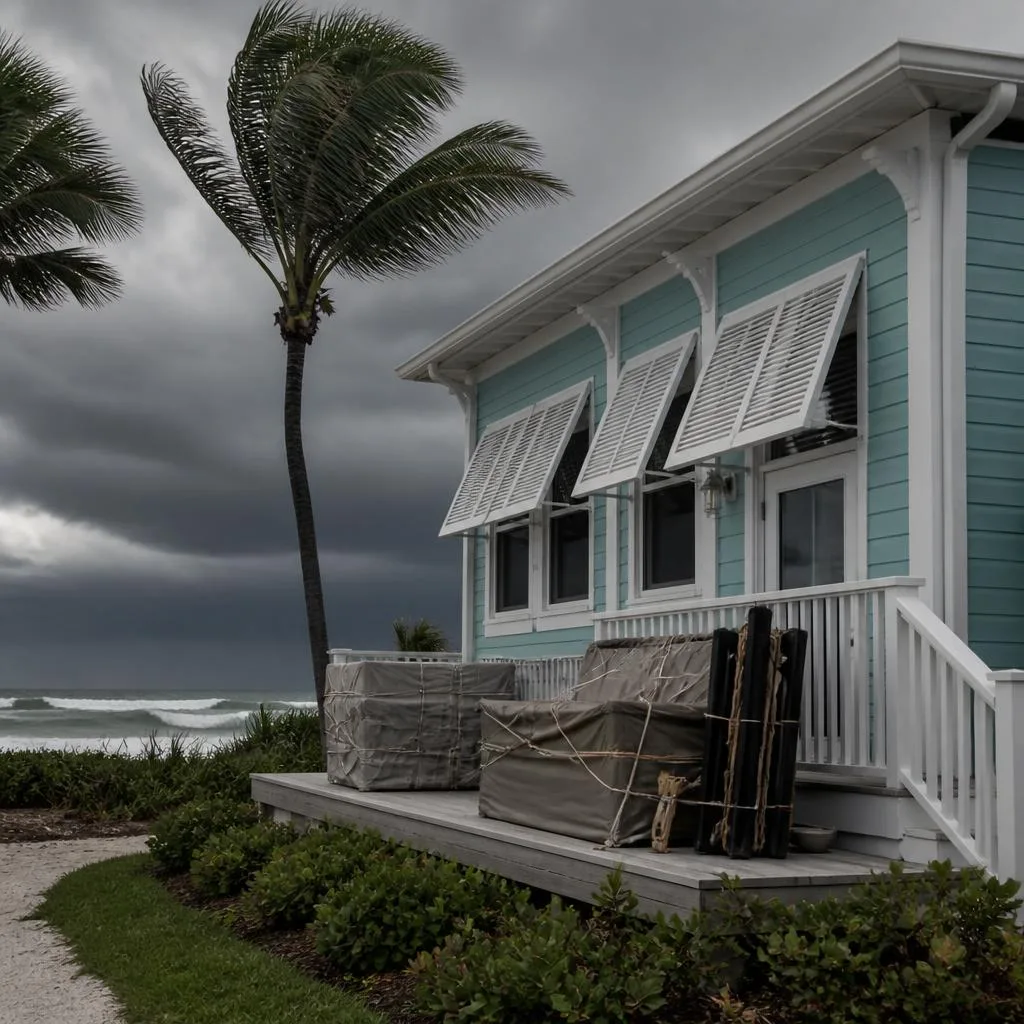
This is the other half — the physical property. What to do to a unit on Siesta Key, Anna Maria Island or Longboat Key before a storm, and what it actually takes to get it back to guest-ready afterwards.
One thing up front, because it is the point most hosts get wrong: for the majority of properties in a normal season, the damage does not come from wind or water. It comes from the power being off for four days in August.
Before: clear the lanai, empty the fridge, lift soft goods off the floor, photograph everything. After: get the AC running and the humidity down before you clean anything. And if water came in from outside, it is a remediation job, not a cleaning one.
The Part You Do in June, Not the Week Of
Some of this only works if it is already done when a storm is named, because the 48 hours before landfall are not the time to be sourcing storage bins or finding out your shutters do not fit.
- Somebody local with keys. If you host from out of state, the single most valuable thing you can arrange is a person who can close the unit up without you booking a flight. Almost everything below takes two hours if someone is nearby and is impossible if nobody is.
- Storage that closes. Sealed bins for linen, and a lockable interior space for lanai furniture. An open spare room is not storage.
- A written unit-specific list. Where the water shut-off is, where the breaker panel is, which windows leak in driving rain, which slider sticks. Whoever secures the property in a hurry should not be discovering that.
- Photograph the unit in good condition now. Not during a watch. A clean baseline set from June is worth more than anything taken in a rush.
Closing Up a Unit Before a Named Storm
Start when a watch goes up for the area and finish well before any evacuation order takes effect — official instructions always come first, and no part of this is worth doing in rising wind.
Four Days Without Air Conditioning in August
A sealed Florida building with no air conditioning does not stay as it was. Indoor humidity climbs into the eighties and nineties within a day or two, and at that level mould does not need a leak — the moisture already in the air is enough for soft materials to support growth.
What that looks like in practice, in the order it becomes a problem:
- Smell first, within a day. Closed air, warm fabric and a still building. It is the thing a returning owner notices at the door before anything visible.
- The freezer, within two to three days. Spoiled food in a warm unpowered appliance is the single worst odour source in the building, and it moves into seals, cabinetry and anything porous nearby.
- Soft furnishings, within a week. Mattresses, upholstery, stored linen and curtains hold humidity long after the air itself dries out. This is where a bad outcome usually hides, because nothing looks wrong.
- Surfaces, last. Visible spotting on walls or ceilings means the problem has been running for a while and has moved past cleaning.
The practical consequence is that the reopening job is not really about dirt. It is about moisture and odour in materials, which is a different job with a different order of operations.
The Order a Reopening Clean Runs In
Doing these in the wrong order wastes most of the effort — cleaning a humid unit simply redistributes moisture.
| Step | Why it sits here in the order |
|---|---|
| 1 · Document before you touch anything | Repeat the before-photos from the same positions and in the same order. Once cleaning starts, the evidence is gone — and matched pairs are what an insurer or a platform actually wants. |
| 2 · Power and air conditioning first | Get the AC running and give it time before any cleaning starts. Wiping surfaces in an 85% humidity room accomplishes very little; the room has to come down first, and that takes hours to days, not minutes. |
| 3 · The fridge and freezer | If they were left with food in them, this is the most time-sensitive job in the building and the one that decides whether the unit smells right. Contents out, seals and gaskets cleaned, and the appliance left open to dry before it is closed and re-cooled. |
| 4 · Soft surfaces, not hard ones | Linen, curtains, upholstery and mattresses hold humidity and odour long after the walls feel dry. Everything washable gets washed; upholstery and mattresses may need extraction rather than a surface pass. |
| 5 · Hard surfaces, glass and screens | Storm-driven salt spray reaches windows well inland and dries to a film that ordinary glass cleaner smears. Screens, slider tracks and the lanai come last on the outside. |
| 6 · The guest-eye walkthrough | Front door to back, the way an arriving guest moves. Smell first, then look. A unit that is visually spotless and smells closed is not ready to let. |
If the unit was closed and unpowered for more than a couple of days, book this as a deep clean rather than a turnover, and allow time before the first booking. Carpets and upholstery that have sat damp need extraction and then drying time — neither compresses into the afternoon before a guest arrives.
For the sequence a normal changeover follows once the property is back to baseline, our turnover playbook covers it, and the linen guide covers rewashing stock that has been in storage.
When It Stops Being a Cleaning Job
This matters more than anything else here, so it is worth being blunt about it. Cleaning and remediation are different trades. If any of the following is true, the property needs a licensed water damage or mould remediation contractor, and a cleaning crew is the wrong call:
Flood water is contaminated whatever it looks like, and porous materials that absorbed it — carpet pad, drywall, mattresses, upholstered frames — generally have to come out rather than be cleaned. Any company that offers to simply clean that away is selling you a problem that comes back in six weeks, usually inside a wall.
We will tell you plainly when a job is past cleaning. It costs us the booking and saves you considerably more.
The Bottom Line
Storm season is a property-management problem long before it is an insurance one. The unit that comes through best is usually the one that was emptied, lifted, photographed and left with the air conditioning running — and the one with somebody local who could do all of that in two hours without a flight being booked.
DS Cleaning handles pre-storm close-ups and post-storm reopening cleans for vacation rentals across Siesta Key, Anna Maria Island, Longboat Key, Holmes Beach, Bradenton Beach and the wider Sarasota area, alongside regular turnover cleaning.
Frequently asked questions
Start the property work when a tropical storm watch goes up for the area, which is usually about 48 hours out, and have it finished before any evacuation order takes effect. Trying to secure a lanai in rising wind is both dangerous and ineffective. If the unit is unoccupied and you live out of the area, that window is short — this is the main argument for having someone local who can do it without you flying in.
For most properties it is not wind or water, it is losing power for several days in August. With the air conditioning off, indoor humidity in a sealed Florida unit climbs into the eighties and nineties within a day or two, and soft furnishings — mattresses, upholstery, curtains, stored linen — start growing mould long before anything looks wrong. A freezer full of food with no power runs a close second, because that smell gets into everything porous and outlasts the food by weeks.
If power stayed on and nothing came inside, airing out plus a standard turnover is usually enough. If the unit was closed and unpowered for more than about two days in summer, treat it as a deep clean: the problem is in soft surfaces rather than on them, and opening windows in Florida humidity can make it worse rather than better. Get the air conditioning running and the humidity down first — cleaning a damp unit just moves moisture around.
Before: every room wide, the lanai and exterior, the roofline from ground level, the contents of the fridge and freezer, and any pre-existing damage so it is not attributed to the storm later. After: the same angles in the same order, before anything is moved or cleaned. Matching sets of before-and-after images from identical positions are far more useful to an insurer or a platform than a folder of close-ups, and they take ten minutes.
When water came in from outside, when anything was standing in water, or when visible mould covers more than roughly a small patch, it is remediation rather than cleaning, and it needs a licensed water damage or mould remediation contractor. Flood water is contaminated regardless of how it looks, and porous materials that absorbed it — drywall, carpet pad, upholstery, mattresses — generally have to be removed rather than cleaned. A cleaning company that tells you otherwise is not doing you a favour.

Nadiia Soroka is the owner of DS Cleaning, a professional residential cleaning company serving Sarasota, Bradenton, and the surrounding Gulf Coast.
More articles by Nadiia →